Hallowfall
Introduction
Hallowfall is my most recent Unity project, a 2D roguelike inspired by soulslike games. I chose the roguelike genre because it's well suited for a solo developer. Its reusable content and system driven design present both creative opportunities and meaningful programming challenges. This project has been the perfect opportunity to establish the groundwork for core systems. My initial goals were to refine existing mechanics, improve code maintainability, and build a scalable foundation for roguelike gameplay. From procedural world to diverse abilities and adaptive enemy AI, I'm hoping that one day the game grows into a rich and challenging experience.
Player Architecture
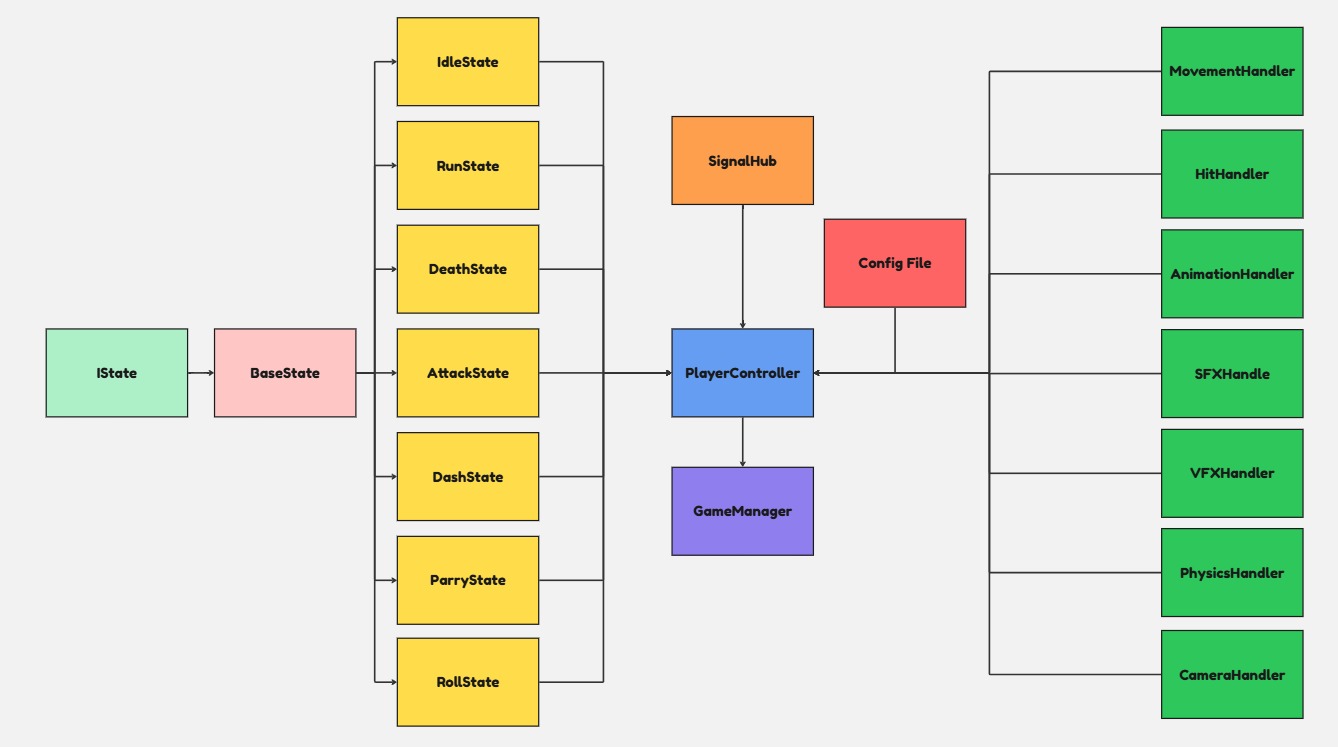
To handle growing complexity around the player character, I designed a scalable, state driven architecture centered on a Finite State Machine (FSM) managed by a PlayerController. The system emphasized clean separation of concerns and event driven communication, ensuring that each behavior existed in an isolated state while remaining decoupled, extensible, and responsive.
- Finite State Machine (FSM): Implemented a FSM managing states such as Idle, Run, Attack and Parry, ensuring smooth and responsive transitions. States are encapsulated in independent classes for easy extension.
- Modular Components: Organized the player into independent systems (Movement, Input, Ability, Animation, etc.), improving maintainability and enabling parallel development of systems.
- Event Driven Communication: Leveraged a centralized SignalHub to decouple interactions between systems, reducing interdependencies and simplifying debugging.
- Combat & Abilities: Developed extensible health, damage, and ability modules, configured via ScriptableObjects. Special abilities can be scaled or modified without altering core systems.
- Animation & Feedback Integration: Dedicated handlers for animations, VFX, and SFX are decoupled from gameplay logic, enabling designers and artists to iterate freely.
- Extensibility & Scalability: Dependency injection ensures modular initialization and reuse of components. Supports adding new states, abilities, or mechanics with minimal disruption to existing code or need to refactor.
-
Player State
public interface IEntityState { void EnterState(); void ExitState(); void FrameUpdate(); void PhysicsUpdate(); } public class PlayerState : IEntityState { protected PlayerStateEnum stateEnum; protected PlayerController playerController; protected PlayerConfig playerConfig; protected PlayerStateMachine stateMachine; protected PlayerSignalHub signalHub; public PlayerState(PlayerController playerController, PlayerStateMachine stateMachine, PlayerConfig playerConfig, PlayerStateEnum stateEnum) { this.playerController = playerController; this.stateMachine = stateMachine; this.playerConfig = playerConfig; this.stateEnum = stateEnum; this.signalHub = playerController.PlayerSignalHub; } public virtual void EnterState() { } public virtual void ExitState() { } public virtual void FrameUpdate() { } public virtual void PhysicsUpdate() { } } -
State Implementation Example
public class PlayerParryState : PlayerState { private PlayerParryShield parryShield; private AudioClip[] parrySFX; private float parryWindow; private bool isParrySuccessful = false; private bool canCounterParry = true; private bool canParryProjectiles = false; public bool CanCounterParry { get => canCounterParry; set => canCounterParry = value; } public bool CanParryProjectiles { get => canParryProjectiles; set => canParryProjectiles = value; } public PlayerParryState(PlayerController playerController, PlayerStateMachine stateMachine, PlayerConfig playerConfig, PlayerStateEnum stateEnum) : base(playerController, stateMachine, playerConfig, stateEnum) { parrySFX = playerConfig.parrySFX; parryWindow = playerConfig.parryWindow; parryShield = playerController.ParryShield; signalHub.OnActivatingParryShield += ActivateParryShield; signalHub.OnEnemyParried += OnSuccessfulParry; signalHub.OnParryEnd += OnParryHoldAnimEnd; } public override void EnterState() { playerController.IsParrying = true; StartParry(); } public override void ExitState() { playerController.IsParrying = false; isParrySuccessful = false; } private void StartParry() { signalHub.OnTurningToMousePos?.Invoke(); signalHub.OnAnimBool?.Invoke("isParrying", true); playerController.CoroutineRunner.RunCoroutine(StopParryCoroutine()); } private IEnumerator StopParryCoroutine() { yield return new WaitForSeconds(parryWindow); OnParryHoldAnimEnd(); } private void OnParryHoldAnimEnd() { parryShield.BoxCollider.enabled = false; if (!isParrySuccessful) { signalHub.OnAnimBool?.Invoke("isParrying", false); signalHub.OnAnimBool?.Invoke("isParrySuccessful", false); signalHub.OnStateTransitionBasedOnMovement?.Invoke(PlayerStateEnum.Parry); } else isParrySuccessful = false; } private void ActivateParryShield() { parryShield.BoxCollider.enabled = true; } private void OnSuccessfulParry(EnemyController enemyController, float parryDamage) { parryShield.BoxCollider.enabled = false; signalHub.OnPlayRandomSFX?.Invoke(parrySFX, 1f); if (CanCounterParry) { isParrySuccessful = true; signalHub.OnAnimBool?.Invoke("isParrySuccessful", true); } } } -
Player Controller
public class PlayerController : MonoBehaviour { private void Start() { InitStats(); InjectDependencies(); stateMachine = new PlayerStateMachine(this); stateMachine.InitAllStates(); GameManager.Instance.InitSkillsFromSkillTree(); } private void Update() { stateMachine.CurrentState?.FrameUpdate(); ManageTimers(); } private void FixedUpdate() { stateMachine.CurrentState?.PhysicsUpdate(); } private void InjectDependencies() { playerInputHandler.Init(this); playerMovementHandler.Init(this); playerHealthBarHandler.Init(this); playerHitHandler.Init(this); playerAnimationHandler.Init(this); playerSFXHandler.Init(this); playerVFXHandler.Init(this); } public void OnMoveInput(Vector2 dir) { playerMovementHandler.SetMovementInputDirection(dir); } public void OnSwordAttackInput() { signalHub.OnChangeState?.Invoke(PlayerStateEnum.SwordAttack); stateMachine.PlayerSwordAttackState.TrySwordAttack(); } public void OnDashInput() { if (CanDash) signalHub.OnChangeState?.Invoke(PlayerStateEnum.Dash); } public void OnParryInput() { if (!isRolling && !isParrying) signalHub.OnChangeState?.Invoke(PlayerStateEnum.Parry); } public void OnRollInput() { if (!isRolling && canRoll) signalHub.OnChangeState?.Invoke(PlayerStateEnum.Roll); } } -
Handler Component Example
public class PlayerSFXHandler : MonoBehaviour, IInitializeable<PlayerController> { private AudioManager audioManager; private PlayerController playerController; private AudioClip[] groundRunSFX; private AudioClip[] grassRunSFX; private AudioClip[] stoneRunSFX; public void Init(PlayerController playerController) { this.playerController = playerController; audioManager = AudioManager.Instance; groundRunSFX = playerController.PlayerConfig.groundSFX; grassRunSFX = playerController.PlayerConfig.grassSFX; stoneRunSFX = playerController.PlayerConfig.stoneSFX; playerController.PlayerSignalHub.OnPlayerStep += PlayStepSound; playerController.PlayerSignalHub.OnPlaySFX += PlaySFX; playerController.PlayerSignalHub.OnPlayRandomSFX += PlayRandomSFX; } private void OnDisable() { playerController.PlayerSignalHub.OnPlayerStep -= PlayStepSound; playerController.PlayerSignalHub.OnPlaySFX -= PlaySFX; playerController.PlayerSignalHub.OnPlayRandomSFX -= PlayRandomSFX; } private void PlaySFX(AudioClip audioClip, float volume) { audioManager.PlaySFX(audioClip, playerController.GetPlayerPos(), volume); } private void PlayRandomSFX(AudioClip[] audioClip, float volume) { audioManager.PlaySFX(audioClip, playerController.GetPlayerPos(), volume); } private void PlayStepSound() { switch (playerController.CurrentFloorType) { case FloorTypeEnum.Ground: PlayRandomSFX(groundRunSFX, 0.25f); break; case FloorTypeEnum.Grass: PlayRandomSFX(grassRunSFX, 0.25f); break; case FloorTypeEnum.Stone: PlayRandomSFX(stoneRunSFX, 0.25f); break; } } } -
Simplified Architecture Diagram
Procedural World Generation System
The Procedural World Generation System is implemented using a dynamic zone based architecture, where the game world is divided into manageable zones that are procedurally generated, activated, and deactivated based on player proximity. Each zone is responsible for generating terrain, props, and gameplay elements according to defined profiles and procedural rules. The core idea revolves around a ZoneManager for high level management and a ZoneHandler for zone specific generation.
- Zone Based Architecture: The world is split into zones, each represented as a grid of Cells, with independent procedural generation for terrain, props, and gameplay elements. Zones are dynamically activated or deactivated based on player proximity.
- ZoneManager: Centralized controller for managing all zones. Tracks player position and proximity to determine which zones to generate, expand, or deactivate. Implements a buffer system to pre-generate zones near the player for seamless exploration.
- ZoneHandler: Responsible for generating the internal layout of a zone, including terrain, props, and environmental details. Integrates with a CellGrid system and implements binary space partitioning for subdividing zones.
- Flow Field Integration: Generates flow fields for each zone to enable dynamic AI pathfinding across the world.
-
Zone Manager
[RequireComponent(typeof(CTicker))] public class ZoneManager : MonoBehaviour { public static ZoneManager Instance { get; private set; } [SerializeField] private int zoneSize = 40; [SerializeField] private int zoneCellSize = 1; [SerializeField] private float zoneBuffer = 25; [SerializeField] private GameObject zonePrefab; [SerializeField] private GameObject mainGrid; [SerializeField] private Tilemap zoneConnectingGround; [SerializeField] private ZoneLayoutProfile zoneLayoutProfile; private GameObject player; private int halfZoneSize; private CTicker cTicker; public Tilemap ZoneConnectingGround => zoneConnectingGround; public Dictionary<Vector2Int, ZoneData> GeneratedZonesDic { get => generatedZonesDic; } private Dictionary<Vector2Int, ZoneData> generatedZonesDic = new(); private void Awake() { if (Instance != null && Instance != this) { Destroy(gameObject); return; } Instance = this; cTicker = GetComponent<CTicker>(); halfZoneSize = zoneSize / 2; } private void Start() { player = GameManager.Instance.Player; cTicker.CanTick = true; TryGenerateZone(Vector2Int.zero, DirectionEnum.None); cTicker.OnTickEvent += CheckForPlayerEdgeProximity; } private void TryGenerateZone(Vector2Int centerCoord, DirectionEnum expansionDir) { if (generatedZonesDic.ContainsKey(centerCoord)) return; Vector3Int newZoneWorldPos = FindZoneCenterPosition(centerCoord); GameObject newZoneGO = Instantiate(zonePrefab, newZoneWorldPos, Quaternion.identity, mainGrid.transform); var zoneData = new ZoneData(zoneCellSize, zoneSize, zoneSize, centerCoord, newZoneWorldPos, newZoneGO, expansionDir, zoneLayoutProfile); generatedZonesDic.Add(centerCoord, zoneData); var zoneHandler = newZoneGO.GetComponent<ZoneHandler>(); zoneHandler.Init(zoneData); } } -
Realtime World Generation Demo
Enemy AI System
The Enemy AI System mirrors the Player Architecture in its overall design, built on a foundation of Finite State Machine (FSM) control, event driven communication, modular components, and isolated systems. The key difference is in the way state transitions happen: enemies react to real time data such as player proximity, health thresholds, or environmental conditions, rather than relying on direct input handlers like the player.
- Finite State Machine (FSM): Implemented an FSM managing states such as Idle, Patrol, Chase, Attack, and Death. Transitions are driven by state specific triggers (e.g., player detection, low health, line of sight checks), enabling smooth and adaptive responses.
- Configuration via ScriptableObjects: Enemy abilities, stats, and behaviors are defined through ScriptableObjects, allowing flexible configuration of combat styles and AI patterns without modifying the core FSM logic.
- Pathfinding with Flow Fields: Enemies navigate procedurally generated zones using flow field pathfinding, coordinated by the MovementHandler component.
- Strategy Pattern for State Variations: Enemies can be assigned different state functionalities of the same type (e.g., multiple attack strategies), enabling highly varied AI behaviors while reusing the same state framework.
-
Enemy Attack State
public class EnemyAttackState : EnemyState { private EnemySignalHub signalHub; private float attackDelay; private List<BaseEnemyAbilitySO> abilityList; private List<BaseEnemyAbilitySO> availaleAbilityList; private BaseEnemyAbilitySO currentAbility; public EnemyAttackState(EnemyController enemyController, EnemyStateMachine stateMachine, EnemyStateEnum stateEnum) : base(enemyController, stateMachine, stateEnum) { signalHub = enemyController.SignalHub; abilityList = enemyController.GetListOfAllAbilities(); availaleAbilityList = new List<BaseEnemyAbilitySO>(abilityList); currentAbility = MyUtils.GetRandomRef<BaseEnemyAbilitySO>(availaleAbilityList); signalHub.OnAbilityFinished += (value) => { EndAttack(); }; signalHub.OnAbilityStart += SetupNextAbility; } public override void EnterState() { if (enemyController.IsAttackDelayOver && availaleAbilityList.Count > 0) { enemyController.CanMove = false; enemyController.CanAttack = false; enemyController.IsAttacking = true; signalHub.OnAbilityStart.Invoke(currentAbility); enemyController.CoroutineRunner.RunCoroutine(PutAbilityOnCooldownCoroutine(currentAbility)); } else stateMachine.ChangeState(EnemyStateEnum.Idle); } public override void ExitState() { enemyController.CanMove = true; enemyController.CanAttack = true; enemyController.IsAttacking = false; currentAbility?.EndAbility(enemyController); } public bool CanChangeToAttackState() { return IsEnemyInAttackRange() && IsEnemyAbleToAttack() && currentAbility != null; } } -
Enemy Ability Example
public class EnemyMeleeStrike : BaseEnemyAbilitySO
{
    public EnemyAttackZone attackZonePrefab;
    private EnemyAttackZone attackZone;

    public int strikeDamage;
    public int parryDamage;

    public override void ExecuteAbility(EnemyController enemy)
    {
        enemy.SignalHub.OnAnimBool?.Invoke(animCondition, true);
        attackZone = Instantiate(attackZonePrefab, enemy.GetEnemyPos(), Quaternion.identity);
        SetupAttackZone(attackZone.gameObject, enemy);
        attackZone.Init(new EnemyMeleeStrikeData { owner = enemy, strikeDamage = this.strikeDamage, parryDamage = this.parryDamage });
        enemy.SignalHub.OnPlayRandomSFX?.Invoke(abilitySFX, 0.075f);
    }

    public override void ActionOnAnimFrame(EnemyController enemy)
    {
        if (attackZone != null)
        {
            attackZone.TryHitTarget(enemy);
            attackZone = null;
        }
    }

    public override void EndAbility(EnemyController enemy)
    {
        enemy.SignalHub.OnAnimBool?.Invoke(animCondition, false);
    }
}
Enemy Pathfinding
The Enemy Pathfinding has evolved with the game. Initially, I used the built in Unity NavMesh to handle enemy pathfinding. However, after completing the first iteration of the World Generation System, I realized that NavMesh would need to be baked at runtime dynamically, causing noticeable performance issues. After exploring some workarounds, I developed a custom pathfinding system using Flow Field Pathfinding. By modifying my CellGrid system from the World Generation section, I successfully integrated the new pathfinding solution.
-
Flow Field Pathfinding Algorithm:
- Cost Fields: Calculates movement costs for each cell based on terrain, obstacles, and proximity to the target.
- Integration Fields: Computes cumulative costs to determine the shortest path efficiently.
- Flow Vectors: Assigns direction vectors to each cell, guiding AI agents toward their destination.
-
AI Agent Usage:
- AI queries flow vectors from the flow field to determine movement direction.
- A repulsion force is calculated to prevent enemies from clumping or overlapping, avoiding the use of colliders which could cause performance overhead.
-
Flow Field Generator
public class FlowFieldGenerator { private const int COST_UNVISITED = (int)CellFlowCost.unVisited; private const int COST_UNWALKABLE = (int)CellFlowCost.unWalkable; private const int COST_TARGET = (int)CellFlowCost.target; public void GenerateFlowFieldOnTargetZone(CellGrid cellGrid, Vector3 targetPos) { Queue<Cell> flowFieldCellQueue = new(); Cell currentFieldTargetCell = cellGrid.GetCellFromWorldPos(targetPos); SetInitialBaseFlowCosts(cellGrid, currentFieldTargetCell, flowFieldCellQueue); ApplyCostsForPlayerZone(flowFieldCellQueue, currentFieldTargetCell); AssignFlowAllDirectionsOnPlayerZone(cellGrid); } private void SetInitialBaseFlowCosts(CellGrid cellGrid, Cell targetCell, Queue<Cell> flowFieldCellQueue) { cellGrid.LoopOverGrid((i, j) => { Cell currentCell = cellGrid.Cells[i, j]; currentCell.BaseCost = currentCell.IsWalkable ? COST_UNVISITED : COST_UNWALKABLE; }); targetCell.BaseCost = COST_TARGET; flowFieldCellQueue.Enqueue(targetCell); } } -
Using the Flow Field Direction
private void FindNextMovementDirection() { flowRequestTimer += Time.deltaTime; if (flowRequestTimer >= flowRequestDelay || hasNotBeenOnFlow) { lastCell = zoneManager.FindCurrentCellFromWorldPos(lastPos); currentCell = zoneManager.FindCurrentCellFromWorldPos(enemyController.transform.position); Vector2 newDir = (flowFieldManager.RequestNewFlowDir(currentCell, lastCell) + CalculateRepulsionForce()).normalized; if (newDir != Vector2.zero) { nextMoveDir = newDir; lastPos = enemyTransform.position; hasNotBeenOnFlow = false; flowRequestTimer = 0; } } } -
Repulsion Force
private Vector2 CalculateRepulsionForce() { Vector2 repulsion = Vector2.zero; float repulsionStrength = 0.2f; float detectionRadius = 1.0f; foreach (EnemyController otherEnemy in enemyController.Detector.DetectNearbyGenericTargetsOnParent<EnemyController>( "EnemyCollider", enemyController.GetEnemyPos(), layerMask, detectionRadius)) { if (otherEnemy == enemyController) continue; Vector2 diff = (Vector2)(transform.position - otherEnemy.transform.position); float distance = diff.magnitude; if (distance < detectionRadius && distance > 0.01f) repulsion += diff.normalized / distance; } return repulsion * repulsionStrength; } -
Enemy Pathfinding Showcase